
The canadian robotic discovery ocean phytoplankton research marks a major step forward in understanding how oceans support life and regulate the planet’s climate. Scientists have long known that phytoplankton play a central role in marine ecosystems, but measuring them accurately across the full depth of the ocean remained a serious challenge.
Canadian-led robotic systems are now closing this gap by delivering continuous, precise data from regions satellites cannot reach. This breakthrough directly supports climate research, marine conservation, and long-term environmental planning.
Phytoplankton as the engine of ocean life
Phytoplankton are microscopic organisms that convert sunlight and carbon dioxide into energy, forming the base of the marine food web. Every larger ocean species depends on them either directly or indirectly. Their daily activity also influences oxygen production and carbon storage on a global scale.
Small changes in phytoplankton populations can signal wider shifts in ocean health. Until recently, scientists could only estimate these changes near the surface. Deeper layers remained largely invisible, limiting the accuracy of climate and ecosystem models.
The limits of surface-based observation
Satellite monitoring transformed ocean science by allowing global coverage, but it comes with blind spots. Light-based sensors cannot penetrate far below the surface, especially in regions with dense water layers or seasonal ice cover. As a result, large phytoplankton populations went uncounted for decades.
These missing measurements created uncertainty in carbon cycle estimates. Climate models relied on partial data, forcing researchers to make assumptions rather than rely on direct observation. The need for a deeper, autonomous monitoring system became increasingly clear.
Canada’s role in advancing underwater robotics
Canadian research institutions have played a leading role in developing underwater robotic systems capable of long-term deployment. These robots operate independently for years, collecting data in harsh and remote environments. Their design reflects decades of expertise in oceanography and marine engineering.
This canadian robotic discovery ocean phytoplankton effort combines national scientific leadership with international collaboration. Canadian teams helped refine sensors, deployment strategies, and data calibration methods that now benefit researchers worldwide.
Biogeochemical-Argo floats and deep-ocean insight
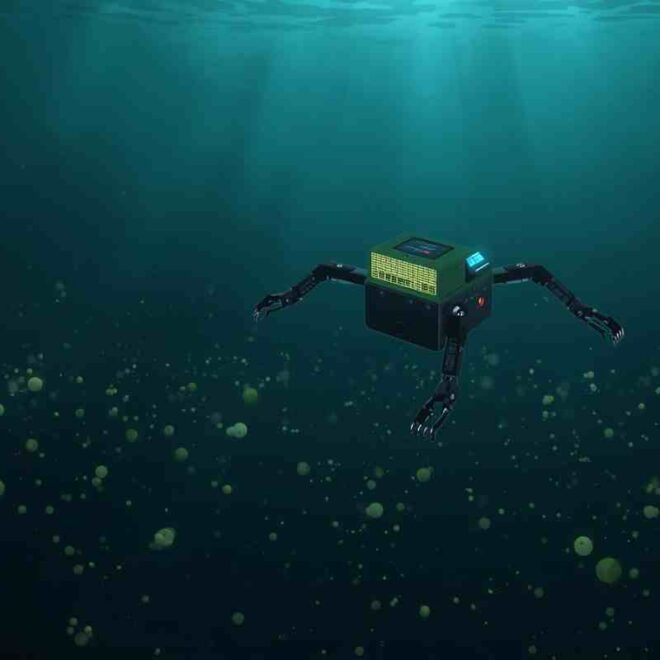
At the heart of this discovery are biogeochemical Argo floats, autonomous robots that drift with ocean currents while diving thousands of meters below the surface. They collect information on phytoplankton biomass, chlorophyll levels, temperature, salinity, and nutrient availability. Each float resurfaces regularly to transmit data via satellite.
This system reveals phytoplankton layers that were previously invisible. In some regions, nearly half of total phytoplankton biomass exists below the range of traditional satellite detection. These findings reshape long-held assumptions about ocean productivity.
Measuring carbon storage with higher accuracy
Phytoplankton absorb carbon dioxide during photosynthesis, making them a crucial part of natural climate regulation. When they die or are consumed, some of that carbon sinks into deeper waters, where it can remain for centuries. Accurate measurement of this process depends on knowing where phytoplankton actually exist.
The canadian robotic discovery ocean phytoplankton data allows scientists to refine estimates of carbon sequestration. Models that once relied on surface indicators can now incorporate deep-water measurements, reducing uncertainty in climate predictions.
Seasonal cycles revealed beneath the surface
One of the most valuable outcomes of robotic monitoring is the ability to track seasonal changes. Phytoplankton blooms do not follow the same patterns at depth as they do near the surface. Some populations peak later in the year or persist longer in deeper layers.
These insights help scientists understand how ocean warming may alter biological rhythms. Changes in timing can disrupt food availability for fish and other marine species, affecting fisheries and biodiversity at a regional level.
Strengthening global climate models
Climate models depend on accurate ocean data to predict long-term trends. When phytoplankton distributions were underestimated, carbon cycle projections carried hidden errors. Robotic observations reduce these gaps by providing consistent, year-round measurements.
The canadian robotic discovery ocean phytoplankton initiative feeds directly into global databases used by climate researchers. Improved inputs lead to better forecasts, supporting evidence-based policy decisions and international climate agreements.
Open data and international collaboration
One defining feature of this robotic monitoring system is open data access. Information collected by the floats is shared freely with scientists around the world. This approach accelerates discovery and encourages cross-border research partnerships.
Over thirty countries now contribute to and benefit from the network. Canadian expertise helped establish standards that ensure data consistency, making it easier to compare results across different ocean regions.
Implications for marine conservation
Understanding phytoplankton distribution helps conservation efforts target vulnerable ecosystems. Areas with declining productivity can be identified earlier, allowing for timely intervention. This is particularly important for regions that support commercial fisheries or endangered species.
Robotic data also aids in evaluating the effectiveness of marine protected areas. By tracking biological changes over time, researchers can assess whether conservation measures are producing real ecological benefits.
Technological resilience in extreme environments
These underwater robots are built to withstand extreme pressure, cold temperatures, and long periods without maintenance. Their reliability makes them ideal for monitoring remote oceans, including polar regions where ship-based research is limited.
Canada’s experience in cold-water engineering has been a major advantage. The canadian robotic discovery ocean phytoplankton systems demonstrate how durable technology can expand scientific reach into previously inaccessible environments.
Bridging biology and chemistry in ocean research
Phytoplankton research sits at the intersection of biology and ocean chemistry. Robotic floats measure not only living organisms but also dissolved oxygen, nitrate levels, and acidity. This combined data paints a fuller picture of ocean processes.
Such integrated measurement helps scientists understand feedback loops. For example, nutrient availability influences phytoplankton growth, which in turn affects carbon uptake and oxygen production. Robots capture these interactions in real time.
Supporting education and future research
Data from robotic ocean monitoring is increasingly used in academic training. Students can work with real-world datasets, improving practical skills in data analysis and climate science. This exposure helps prepare the next generation of oceanographers.
The canadian robotic discovery ocean phytoplankton project also inspires new research questions. As deeper layers are explored, scientists are uncovering patterns that challenge older theories and open new avenues for investigation.
Economic relevance beyond pure science
Healthy phytoplankton populations underpin fisheries that support millions of livelihoods. Accurate monitoring helps predict changes that could affect fish stocks and coastal economies. Early warnings allow industries to adapt more effectively.
Reliable ocean data also supports sustainable resource management. Governments can use scientific evidence to balance economic activity with environmental protection, reducing long-term risk.
Continuous improvement through innovation
Robotic technology continues to evolve, with sensors becoming more sensitive and energy-efficient. New designs aim to measure additional biological markers, offering even richer datasets. Software updates improve data transmission and error correction.
Canada remains actively involved in refining these systems. The canadian robotic discovery ocean phytoplankton initiative is not a single achievement but part of an ongoing process of technological and scientific advancement.
A clearer picture of ocean health
By combining depth, duration, and accuracy, robotic monitoring offers a more complete understanding of ocean health. Phytoplankton patterns once hidden now inform global assessments of climate stability and ecosystem resilience.
This clearer picture helps align scientific knowledge with real-world decision-making. From climate policy to conservation planning, reliable data strengthens every step.
Long-term significance for climate science
The impact of this discovery extends far beyond oceanography. Improved carbon cycle measurements influence global climate strategies and emissions targets. As models become more accurate, uncertainty in future projections decreases.
The canadian robotic discovery ocean phytoplankton research stands as a reminder that technological innovation can unlock critical environmental knowledge. By seeing deeper into the ocean, humanity gains a better chance to protect the planet.
FAQs
How does this discovery change what we know about phytoplankton distribution?
It shows that a large portion of phytoplankton exists deeper in the ocean than satellites can detect. This helps scientists build more accurate climate and ecosystem models.
Why is the canadian robotic discovery ocean phytoplankton research important for climate studies?
Because it improves carbon cycle measurements by including deep ocean data. This reduces uncertainty in climate predictions and long term planning.
Can this technology detect early signs of ocean ecosystem stress?
Yes, continuous monitoring helps identify unusual changes in phytoplankton patterns. These shifts can signal warming effects or nutrient imbalances early on.
Who can access the data collected by these underwater robots?
The data is openly shared with researchers worldwide. This supports global collaboration and faster scientific progress.
Does this research have practical benefits beyond science?
It supports fisheries management, conservation planning, and climate policy decisions. Accurate data helps reduce environmental and economic risks.