
Data teams across the United States are under more pressure than ever to deliver fast, accurate, and repeatable insights. Manual pipeline management slows everything down, introduces human error, and makes scaling nearly impossible.
That is why AI tools for automating Python data analysis pipelines have become one of the most searched and most adopted categories in the modern data stack.
Whether you work at a Series A startup in Austin or a Fortune 500 company in Chicago, the right automation layer on top of your Python workflows can cut hours of repetitive work down to minutes.
In this guide, we cover exactly which tools are leading the space in 2026, how they integrate with your existing Python environment, and what to look for before you commit to a platform.
Why automation is now essential for Python data pipelines
A few years ago, automating a Python data pipeline meant writing your own scheduling scripts, managing cron jobs, and hoping nothing broke over the weekend. That approach still works, but it does not scale. As datasets grow larger and stakeholder expectations rise, data engineers need systems that can handle dependency management, failure recovery, monitoring, and intelligent reruns without constant babysitting.
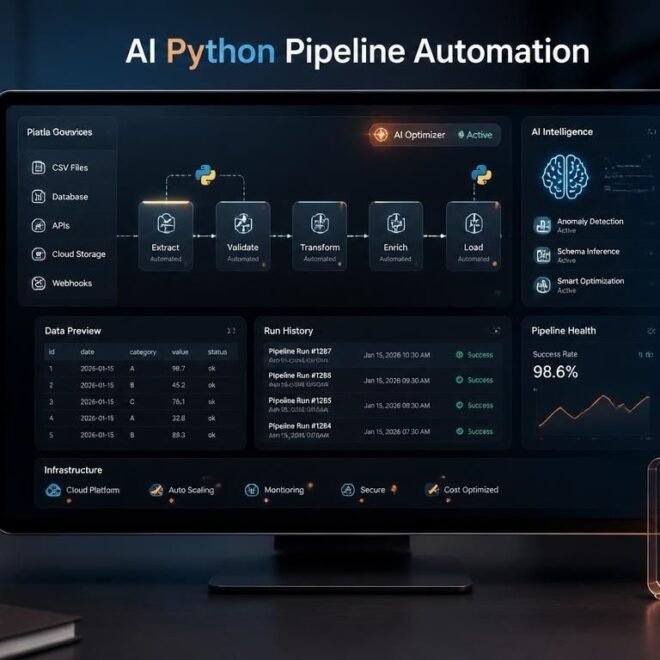
The shift in 2026 is that AI has moved beyond simple orchestration into active pipeline intelligence. Modern tools do not just run your scripts on a schedule. They analyze execution logs, predict failures before they happen, suggest code optimizations, and even auto-generate transformation logic from plain English descriptions. For US data teams dealing with multi-source ingestion, real-time streaming, and complex feature engineering, this level of intelligent automation is no longer a nice-to-have. It is a competitive requirement.
Python remains the dominant language for data work in the US market, which means the best tools in this space are built Python-first. Libraries like Pandas, Polars, and DuckDB sit at the core of most pipelines, and the AI layer wraps around them rather than replacing them.
Top AI tools leading Python pipeline automation in 2026
Several platforms have pulled ahead of the field this year. Each takes a slightly different approach to the automation problem, so the right choice depends on your team size, existing infrastructure, and specific workflow needs.
Prefect 3 with its AI-assisted flow suggestions has become a go-to for mid-size US data teams. It wraps your existing Python functions with minimal code changes and now includes an LLM-powered assistant that recommends retry strategies and caching configurations based on your historical run data. The open-source core is free, making it accessible for lean teams.
Dagster continues to strengthen its asset-centric model, and its 2026 release introduced an embedded AI assistant that can generate asset definitions from data contract descriptions. For organizations running dbt alongside Python, the native integration remains best in class.
Mage AI has carved out a strong position specifically for teams who want an interactive, notebook-style interface with full pipeline automation underneath. Its drag-and-drop pipeline builder now includes an AI code generator that writes transformation blocks in Python based on natural language prompts, dramatically reducing time-to-pipeline for analysts who are not full engineers.
For real-time and streaming use cases, Bytewax combined with AI-assisted schema detection has become the lightweight, Pythonic answer to heavier JVM-based streaming systems. US fintech and e-commerce teams in particular have adopted it heavily for event-driven pipeline automation.
Key features to evaluate before choosing a tool
Not every team needs the same capabilities. Before selecting AI tools for automating Python data analysis pipelines, map your current pain points honestly. Here are the most important feature categories to evaluate in 2026.
Intelligent failure recovery matters more than most teams realize until they are debugging a 3 AM pipeline failure. Look for platforms that offer automatic retry with backoff, root cause analysis powered by log embeddings, and Slack or PagerDuty alerting with AI-generated summaries that tell you exactly what broke and why.
Code generation quality is the new differentiator. The best tools can take a plain English description of a transformation and produce production-ready Python that handles null values, type coercion, and edge cases. Test this feature rigorously during your trial period rather than relying on vendor demos.
Observability and data quality checks need to be built in, not bolted on. Platforms that integrate with Great Expectations or include their own AI-powered anomaly detection will save your team from silently broken pipelines that pass execution but produce wrong outputs.
Finally, consider your cloud environment. Most US enterprise teams run on AWS, GCP, or Azure, and the best Python pipeline tools have native integrations with S3, BigQuery, Snowflake, Redshift, and Databricks. Switching costs are high, so verify compatibility before signing any annual contract.
How to integrate AI automation into an existing Python workflow
One of the most common mistakes teams make is treating pipeline automation as a full migration project. It does not have to be. The practical approach in 2026 is to wrap your existing scripts incrementally rather than rewriting them from scratch.
Start by identifying your three highest-failure or highest-maintenance pipelines. Wrap them with a lightweight orchestrator like Prefect or Dagster using their decorator-based syntax, which requires minimal changes to your existing Python code. Enable the AI monitoring features and let the system collect baseline run data for two to four weeks.
Once you have observability in place, use the AI code generation features to accelerate new pipeline development rather than retrofitting old ones. This hybrid approach lets your team build confidence in the tool while continuing to deliver on existing data commitments.
For teams using Jupyter notebooks as the starting point for analysis, tools like Mage AI and Marimo offer a path from exploratory analysis to automated pipeline without context-switching to a different environment. The notebook becomes the pipeline definition, which removes a major translation step that traditionally required a dedicated data engineer.
Frequently asked questions
What makes 2026 AI pipeline tools different from traditional Python schedulers like Airflow or cron?
Traditional schedulers simply trigger scripts at set times with no awareness of what is happening inside them. Modern AI-powered tools actively monitor execution, learn from historical run patterns, generate and optimize code, detect data quality anomalies, and provide intelligent failure summaries. The intelligence layer is what separates them from a smarter cron job.
Do I need to be an expert Python developer to use AI tools for automating Python data analysis pipelines?
Not necessarily. Several 2026 platforms like Mage AI are specifically designed for data analysts with intermediate Python skills. The AI code generation features handle much of the boilerplate, and the visual pipeline builders reduce the amount of raw code you need to write. That said, a basic understanding of Python functions, data types, and package management will still make you significantly more effective.
Which industries in the USA are adopting Python pipeline automation fastest?
Financial services, healthcare analytics, e-commerce, and SaaS companies are leading adoption in the US. These industries share a common need for high-frequency, reliable data pipelines that feed machine learning models, business intelligence dashboards, and real-time decision systems. Regulatory pressure in finance and healthcare also drives demand for reproducible, auditable pipeline automation.
The data engineering landscape in 2026 rewards teams that automate intelligently, not just teams that automate more. AI tools for automating Python data analysis pipelines have reached a maturity level where they genuinely reduce toil, improve data quality, and accelerate the path from raw data to business decision. For US data teams looking to stay competitive, the question is no longer whether to adopt these tools but which ones fit your stack, your team’s skill level, and your scalability goals. Start small, instrument your most critical pipelines first, and let the AI layer prove its value before expanding. The productivity gains speak for themselves.