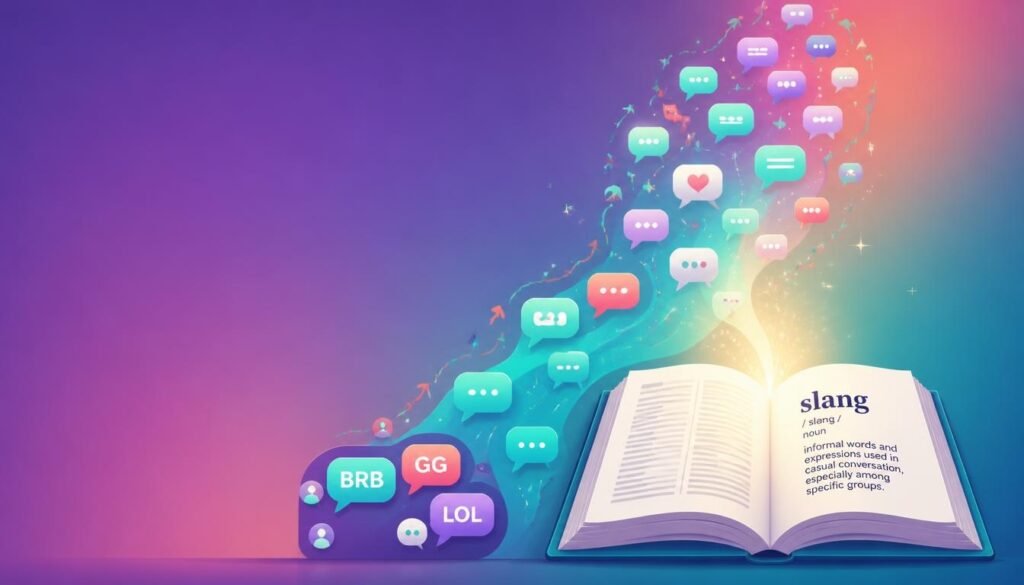

A few years ago, nobody outside a handful of online communities had heard the word “rizz.” Then, in 2023, Oxford University Press named it Word of the Year. A slang term that began in streaming chats and short videos had become dictionary-worthy in a matter of months.
This is not a one-off. Internet slang moves faster than any form of language before it. Understanding where it comes from, and why some words survive while others vanish within weeks, says a lot about how people communicate today.
Slang Has Always Existed. The Internet Just Sped It Up
Slang is not new. Every generation invents words to signal belonging, humor, or rebellion. Jazz musicians, sailors, and students all had their own vocabularies long before smartphones existed.
What the internet changed is speed and reach. Before, a new expression might take years to travel from one city to another. Today, a phrase used in one video can be repeated by millions of people within days. Geography no longer limits who gets to hear it.
Stage 1: Birth in Small Communities
Most slang starts inside a tight group: gamers on Discord, fans in a Reddit thread, friends in a group chat, or viewers of a particular streamer. These groups share inside jokes, and the language they create works like a handshake. If you understand it, you belong.
There are a few common sources:
- Gaming culture: Terms like “GG” (good game) and “noob” came from online play, where typing quickly mattered.
- Texting shortcuts: Abbreviations such as “BRB” and “LOL” started as ways to save time in early chat rooms and messaging tools.
- Marginalized and subcultural communities: Many popular terms, including “slay” and “no cap,” have roots in Black American English and LGBTQ+ ballroom culture before the wider internet adopted them.
- Memes and viral videos: A single quote or sound can turn into everyday vocabulary almost overnight.
Stage 2: Social Platforms Act as Amplifiers
Once a phrase leaves its original community, platforms like TikTok, Instagram, Snapchat, and X (formerly Twitter) carry it further. Their recommendation systems reward content that gets quick reactions, so catchy, repeatable phrases spread quickly.
Trends and challenges also help. When thousands of creators use the same phrase in different videos, it starts to feel familiar even to people who never saw the original source. Familiarity is what turns a niche word into a widely recognized one.
Stage 3: Meaning Starts to Shift
As a term spreads, its meaning often changes. Sometimes it broadens, sometimes it flips entirely, and sometimes it becomes ironic.
This is why abbreviations can be confusing. The same letters might mean one thing in a business email and something completely different in a private message. Take “PMO.” In an office setting it usually means Project Management Office, while in casual chats it can be a slang expression whose meaning depends entirely on the conversation. Context is the only reliable guide.
That constant drift is also why dictionaries and guides need regular updates. If you want a deeper look at how internet slang changes over time, it helps to follow a few terms from their first appearance to their current use.
Stage 4: Mainstream Adoption (or the Cringe Zone)
There are two possible outcomes once a word reaches a large audience.
Path one: it becomes mainstream. News outlets, brands, and even teachers begin using it. Some terms settle permanently into everyday language, like “ghosting” or “selfie.” Others get official recognition, as “rizz” did.
Path two: it becomes “cringe.” The moment older audiences or corporate accounts adopt a slang term, younger users often abandon it. A word that feels fresh in one month can feel outdated the next. Slang survives partly by staying slightly out of reach.
Both outcomes show that popularity and longevity are not the same thing.
Why Some Slang Lasts and Some Disappears
Not every phrase gets a long life. The ones that stick usually share a few traits:
- They fill a gap. If a word expresses something that previously took a whole sentence, people keep using it.
- They are easy to say or type. Short words and abbreviations spread faster.
- They are flexible. A term that works as a noun, verb, and adjective gets reused in many situations.
- They carry emotion or humor. Words that express a feeling precisely tend to be remembered.
Terms tied to a single meme or event, by contrast, usually fade when the moment passes.
What This Means for Everyday Readers
You do not need to speak every new slang word to communicate well, but a little awareness goes a long way.
- Check context first. The platform, the sender, and the surrounding message usually reveal the intended meaning.
- Do not force it. Using slang you do not fully understand can come across as awkward.
- Stay curious. Language is a living thing, and new words are a sign of creativity rather than decline.
Parents, teachers, marketers, and managers all benefit from knowing the basics, because slang shows up in classrooms, comment sections, and even workplace chats.
Final Thoughts
Internet slang follows a surprisingly predictable path: it starts in a small community, spreads through social platforms, shifts in meaning, and then either enters the mainstream or fades away. Behind every new term is a group of people trying to express something in a faster, funnier, or more personal way.
The next time a strange new word appears in your feed, you will know it is probably at the beginning of that journey.