
Introduction
In the realm of precision manufacturing, particularly for medical devices, consumer electronics, and high-end industrial equipment, the demand for mirror-grade surfaces (e.g., Ra ≤ 0.1 μm) on stainless steel parts is increasingly critical. However, many manufacturers pursuing this finish often grapple with low yield rates, uncontrollable costs, and surface defects like orange peel or scratches.
These challenges frequently stem from a fragmented understanding of “precision manufacturing.” A common misconception is that high accuracy depends solely on CNC equipment, overlooking the synergistic roles of materials science, heat treatment, multi-stage polishing handcraft chains, and systematic quality control. Addressing any single aspect in isolation often yields diminishing returns.
This article deconstructs the three core pillars for achieving high-yield stainless steel mirror processing: the foundation of high-precision CNC milling, the scientific selection of materials, and strategies for cost and supplier optimization. By drawing on advanced production technologies and authoritative research, it outlines a clear path for improvement.
Why is High-Precision CNC Milling the Cornerstone of Mirror Finishing, Not Just Post-Processing?
The essence of achieving a mirror finish on stainless steel is attaining an extremely low surface roughness (Ra value). This cannot be accomplished by post-processing alone; it requires creating a near-perfect geometric substrate during the High-Precision CNC Milling stage. A rough, chatter-marked milled surface will magnify defects during polishing, leading to orange peel or localized over-polishing.
Therefore, building this mirror substrate relies on a suite of systematic Precision Manufacturing Technology. This includes utilizing multi-axis capabilities for machining complex contours, optimizing tool paths to eliminate vibration patterns, and operating in a controlled environment to mitigate thermal distortion of both material and machine. As emphasized by the Society of Manufacturing Engineers in their title on precision manufacturing, this is an integrated engineering system.
A robust quality assurance system is key to ensuring first-process consistency. Manufacturers certified to standards like ISO 9001 and IATF 16949 integrate Statistical Process Control (SPC) into the production of CNC Milling Parts, monitoring critical dimensions in real-time. This rigorous process control is a prerequisite for achieving high final polishing yields, guaranteeing every batch of parts enters the polishing stage from a consistently high-quality starting point.
How to Scientifically Select Stainless Steel Material to Optimize Mirror Machinability and Control Cost?
In the domain of metal CNC milling, material choice fundamentally dictates the potential and cost of mirror finishing. Scientific selection is central to balancing performance, machinability, and budget.
Material Science: The Foundation for a Flawless Finish
The pursuit of a perfect mirror polish begins with material science. A manufacturer’s expertise in selecting and validating the right alloy is paramount for both performance and cost.
l Stainless Steel Grade Comparison
Common grades like 304 offer general corrosion resistance, while 316L is preferred for high-end medical or marine applications due to its superior homogeneity from added molybdenum, yielding a more uniform polish. High-strength 17-4PH is more challenging and costly to polish.
l Microstructural Imperfections
The internal metallurgy dictates final quality. Coarse grains or non-metallic inclusions (sulfides, oxides) can cause post-polish defects like hairline streaks. Research confirms polishing performance is tied directly to this metallurgical quality.
The Critical Role of the Supplier
A professional Custom stainless steel parts manufacturer adds value beyond quoting. They provide application-specific guidance—recommending medical-grade 316L for implants or corrosion-resistant alloys for food machinery—using in-house testing to mitigate risks and control total cost.
CNC Milling Cost Structure Analysis: How to Optimize Budget While Pursuing Mirror Quality?
Understanding the composition of CNC Milling Cost is essential for budget optimization when pursuing mirror quality. The total cost of a stainless steel mirror-finished part primarily includes: raw material cost, programming and machine time, tool wear, and the most time-consuming aspect—labor and consumable costs for multi-stage polishing. The duration of finish machining and the complexity of the polishing process are often the main variables.
Costs can be significantly reduced through Design for Manufacturing (DFM) optimization. Examples include avoiding excessively deep or narrow cavities, which necessitate long-reach tools causing vibration, making both machining and polishing difficult; relaxing tolerance requirements on non-critical fitments; and standardizing fillet radii to reduce tool changes and polishing tool swaps. Such design optimizations directly reduce machining difficulty and hours.
From a technological trade-off perspective, employing Advanced Production Technology like 5-axis machining centers, despite higher machine rates, allows for completing multi-sided machining of complex parts in a single setup. This reduces error accumulation and repeated setup times associated with multiple fixtures. For mirror parts with complex contours, this can enhance overall production efficiency and first-pass yield, demonstrating a total cost advantage.
What Core Metrics Beyond Price Should Be Prioritized When Sourcing CNC Milling Parts Online?
Sifting through online searches for “CNC milling parts online” requires looking beyond price. A capable Custom stainless steel parts manufacturer is vetted through a multi-faceted assessment. First, evaluate technical capabilities: machine precision, material/process expertise, and relevant quality certifications (e.g., ISO 13485).
Crucially, assess their engineering support; a proactive partner offering free DFM analysis prevents costly errors. Finally, gauge real-world competence by studying detailed case studies, especially for complex mirror finishing in your sector, to verify proven success with yield and specific challenges.
Case Study: How to Achieve 99.5% Yield in Mirror Finishing for a Complex Curved Stainless Steel Enclosure?
The Project Challenge: High-Volume, Ultra-Mirror Finishing
An international beauty device project demanded mass production of 50,000 monthly units of a complex 3D 316L stainless steel enclosure with a flawless Ra 0.05μm ultra-mirror finish and a yield target >99%. The strict cosmetic standard meant any scratch or orange peel defect would reject the part, presenting a significant manufacturing challenge.
A Systematic Solution for Success
JS Precision addressed this by implementing a holistic Precision Manufacturing Technology strategy, ensuring first-article approval and a sustained yield exceeding 99.5%.
l Integrated Technical Execution
The process began with 5-axis CNC milling to create a perfect substrate. For the complex surfaces, a dedicated, automated polishing cell with custom fixtures and a DOE-optimized progression from sandpaper to diamond paste was developed.
l Digital Quality Assurance
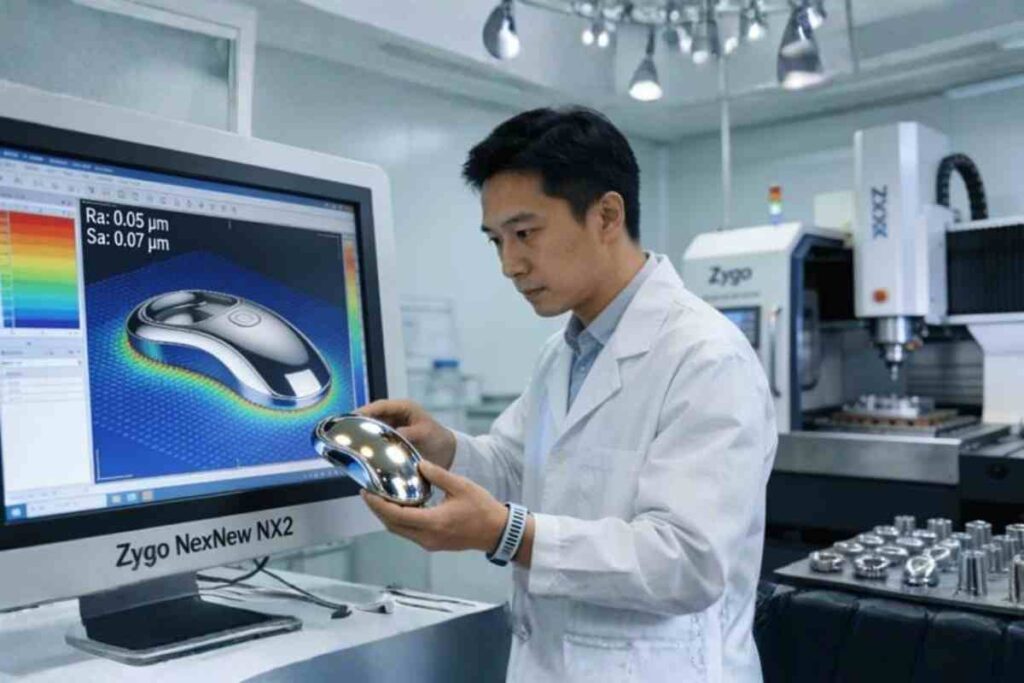
Full-process control was enabled by in-line white light interferometers for 100% inspection and SPC for real-time monitoring of surface parameters, allowing for predictive adjustments and consistent quality.
Conclusion
Achieving stable, high-yield mirror finishes on stainless steel parts is a rigorous systems engineering endeavor. It is rooted in the geometric and surface foundation laid by High-Precision CNC Milling, built upon a deep understanding of material metallurgy, and managed through scientific cost optimization and prudent supplier selection across the entire value chain. Only by moving beyond an overemphasis on any single piece of equipment or process step, and establishing a holistic, systematic precision manufacturing mindset, can manufacturers truly break through the bottlenecks of quality and cost to build lasting competitiveness in high-end manufacturing.
For those grappling with the surface quality or processing yield of stainless steel parts, it is advisable to initiate a technical dialogue with a partner possessing rich experience and technical strength. Obtaining a professional DFM analysis and a tailored stainless steel CNC milling services proposal for your project is the first step toward success.
Author Bio
This article is written by a precision manufacturing consultant with over 15 years of experience, specializing in providing manufacturing process optimization and supply chain solutions for the aerospace, medical device, and high-end consumer electronics industries. He focuses on integrating advanced production technologies with practical quality management frameworks to address complex engineering challenges.
FAQs
Q1: What is the highest surface roughness achievable for stainless steel mirror finishing?
A1: Through mechanical polishing, stainless steel parts can achieve a mirror finish as high as Ra=0.025μm. Electro-polishing, typically used for complex geometries, can achieve an average of Ra=0.1μm. The specific achievable grade depends on the material, initial machining condition, and process.
Q2: What are the main factors affecting the cost of mirror polishing for stainless steel CNC milling parts?
A2: Key factors include: part geometric complexity (deep cavities, sharp corners increase cost), required surface roughness (lower Ra values require longer polishing times), material hardness, and production volume. High-volume production can amortize unit costs through optimized fixtures and parameters.
Q3: How to evaluate the true mirror finishing capability of an online CNC milling supplier?
A3: Focus on four key aspects: 1) Request physical samples of mirror-finished parts in similar materials for personal inspection; 2) Review their inspection equipment list (e.g., white light interferometer); 3) Inquire about their polishing process chain and Standard Operating Procedures; 4) Verify relevant industry quality certifications (e.g., ISO 9001).
Q4: What should be considered when selecting stainless steel material and surface treatment for medical device parts with strict sterile requirements?
A4: Medical-grade stainless steel (e.g., 316L V) must be selected. For surface treatment, electro-polishing should be prioritized as it creates a uniform, passivated chromium oxide layer that is corrosion-resistant and easy to clean and sterilize. The supplier should preferably hold ISO 13485 (Medical Devices Quality Management System) certification.
Q5: How to conduct a basic mirror quality check after receiving custom stainless steel parts?
A5: Visually inspect under standard lighting for scratches, orange peel, or haze. More professional checks involve using a roughness tester to measure Ra values, or shining a parallel light source (e.g., a phone flashlight) onto the part’s surface and observing the continuity and distortion of the reflected light band to judge flatness.