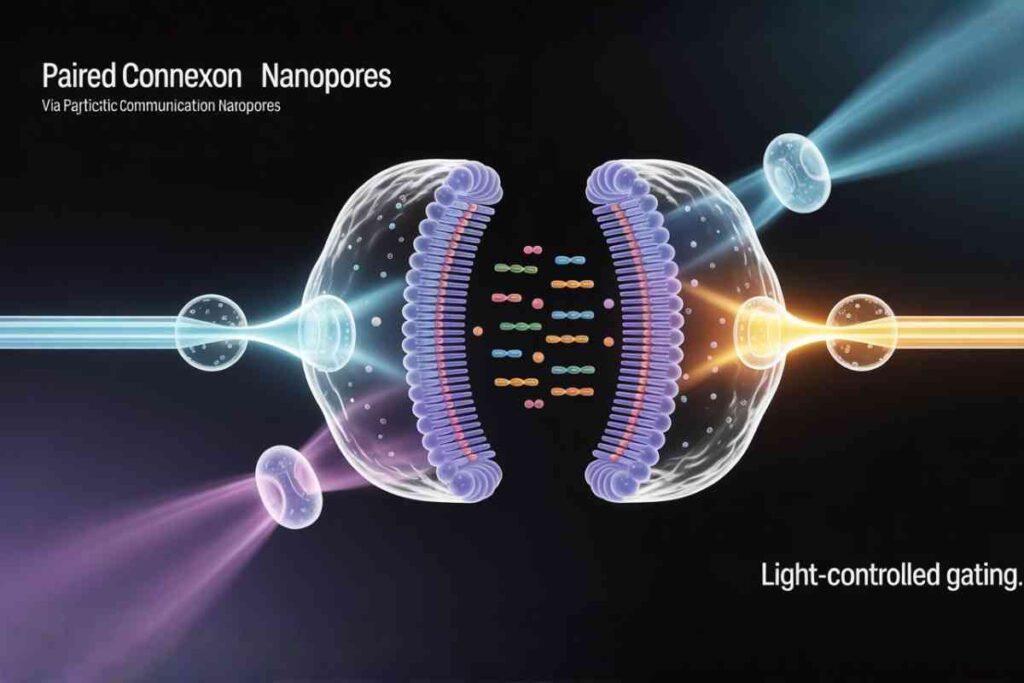

Light-controlled synthetic communication networks via paired connexon nanopores are opening a new chapter in how cells and artificial systems can communicate. Instead of relying only on chemical signals or electrical impulses, researchers are now designing systems where light can control how molecules move between compartments.
This idea may sound complex at first, but the core concept is simple. Scientists are building tiny channels, inspired by natural cell structures, and using light to control when these channels open or close. This allows precise control over communication at a microscopic level.
In this guide, you will understand how these systems work, why they matter, and where they are heading in the future.
What Are Light-Controlled Synthetic Communication Networks?
Light-controlled synthetic communication networks via paired connexon nanopores are engineered systems that mimic how cells exchange information, but with added control using light.
In natural biology, cells communicate through channels called gap junctions. These channels are made from proteins known as connexons. Scientists have taken inspiration from this and created synthetic versions that can be controlled externally.
Here’s the key idea:
- Synthetic nanopores act as communication channels
- These nanopores are paired to allow exchange between two compartments
- Light acts as a switch to control when communication happens
This creates a system where communication is not only possible but programmable.
Understanding Connexon Nanopores in Simple Terms
Connexon nanopores are tiny protein-based channels. In natural systems, they connect two cells and allow ions and small molecules to pass through.
In synthetic systems, researchers recreate these channels using engineered proteins or nanomaterials.
Think of it like this:
- Each nanopore is a gate
- Two gates align to form a tunnel
- Molecules pass through this tunnel
What makes synthetic versions special is that scientists can modify them. They can change size, selectivity, and responsiveness.
This flexibility is what makes them ideal for building communication networks.
How Light Controls These Networks
Light plays a central role in controlling these systems. Instead of permanently open channels, researchers design nanopores that respond to specific wavelengths of light.
When light is applied:
- The nanopore structure changes
- The channel opens or closes
- Molecules can either pass or get blocked
This process is often achieved using photoresponsive molecules. These molecules change shape when exposed to light, which directly affects the nanopore behavior.
For example:
- UV light may open the channel
- Visible light may close it
This allows precise timing and control without physical contact.
Why Pairing of Connexon Nanopores Matters
The pairing aspect is critical in light-controlled synthetic communication networks via paired connexon nanopores.
A single nanopore is not enough for communication between compartments. You need two aligned nanopores to form a complete pathway.
This pairing ensures:
- Selective communication between two defined regions
- Controlled transfer of molecules
- Reduced leakage or unwanted interactions
It also allows researchers to design networks, not just single connections. Multiple paired nanopores can form complex communication pathways.
Key Components of These Systems
To fully understand how these networks work, it helps to break them into core components.
Synthetic Nanopores
These are the main channels. They are engineered to mimic biological pores but with added control features.
Photoresponsive Elements
These components react to light and control the opening or closing of nanopores.
Membrane Structures
Nanopores are embedded in membranes, which separate different compartments or environments.
Signaling Molecules
These are the molecules that pass through the nanopores. They carry information between compartments.
Each component plays a specific role, and together they form a functional communication system.
Applications in Synthetic Biology
One of the most exciting areas for light-controlled synthetic communication networks via paired connexon nanopores is synthetic biology.
Scientists are building artificial cells that can behave like living systems. Communication between these cells is essential.
With light-controlled nanopores, researchers can:
- Control when artificial cells exchange signals
- Synchronize behaviors across cell populations
- Create programmable biological circuits
This opens the door to designing systems that behave like tissues or even simple organisms.
Use in Drug Delivery Systems
Another important application is targeted drug delivery.
Traditional drug delivery often lacks precision. Drugs spread throughout the body, which can cause side effects.
With these nanopore systems:
- Drug release can be controlled using light
- Specific areas can be targeted
- Timing can be adjusted precisely
For example, a drug carrier could remain inactive until exposed to light at a specific location. Once activated, nanopores open and release the drug.
This approach improves both safety and effectiveness.
Role in Bioelectronics and Nanotechnology
Light-controlled synthetic communication networks via paired connexon nanopores are also important in bioelectronics.
These systems can act as interfaces between biological and electronic systems.
Key possibilities include:
- Biosensors that respond to light signals
- Smart materials that change behavior based on external input
- Integration with wearable or implantable devices
In nanotechnology, these nanopores can be used to build highly controlled systems at the molecular level.
Advantages Over Traditional Communication Systems
These light-controlled systems offer several advantages compared to traditional methods.
High Precision
Light allows very precise control over when and where communication happens.
Non-Invasive Control
No physical contact is needed. Light can control the system remotely.
Reversible Operation
Channels can open and close multiple times without damage.
Scalability
Multiple nanopores can be combined to create complex networks.
These benefits make them highly versatile and useful in many fields.
Challenges and Limitations
Despite their potential, there are still challenges to overcome.
Stability Issues
Synthetic nanopores may degrade over time, especially in complex environments.
Light Penetration Limits
Light does not penetrate deeply into tissues, which can limit some applications.
Complexity in Design
Creating stable and efficient paired nanopore systems requires advanced engineering.
Cost and Scalability
Producing these systems at a large scale is still expensive.
Researchers are actively working on solutions, but these challenges are important to consider.
Recent Research and Developments
Recent studies have shown significant progress in this field.
Scientists are now able to:
- Design nanopores with higher selectivity
- Use different wavelengths for multi-level control
- Integrate these systems into living cells
Some research also focuses on combining light control with other triggers, such as temperature or chemical signals.
This multi-trigger approach can create even more advanced communication systems.
Future Potential and Innovations
The future of light-controlled synthetic communication networks via paired connexon nanopores looks promising.
In the coming years, we may see:
- Fully programmable artificial tissues
- Smart drug delivery systems used in clinical settings
- Advanced biosensors for real-time monitoring
There is also potential for combining these systems with artificial intelligence. This could lead to adaptive systems that respond to changing conditions automatically.
Comparison with Natural Cell Communication
To better understand their value, it helps to compare these systems with natural cell communication.
| Feature | Natural Systems | Synthetic Light-Controlled Systems |
|---|---|---|
| Control | Limited | Highly programmable |
| Responsiveness | Biological signals | Light-based triggers |
| Precision | Moderate | Very high |
| Flexibility | Fixed structure | Customizable design |
This comparison shows why researchers are excited about synthetic approaches.
Practical Example of How It Works
Let’s look at a simple example.
Imagine two artificial cells connected by paired nanopores. Inside one cell, there is a signaling molecule.
When light is applied:
- The nanopores open
- The molecule moves to the second cell
- The second cell responds, for example by producing a protein
When the light is turned off:
- The nanopores close
- Communication stops
This simple system can be expanded into more complex networks.
Why This Topic Matters Today
This field sits at the intersection of biology, physics, and engineering. It represents a shift toward more controlled and programmable biological systems.
As technology advances, the need for precise control at the microscopic level is increasing.
Light-controlled synthetic communication networks via paired connexon nanopores provide a solution that is:
- Flexible
- Precise
- Scalable
That’s why this topic is gaining attention in both research and industry.
Conclusion
Light-controlled synthetic communication networks via paired connexon nanopores are transforming how we think about communication at the microscopic level.
By combining biology with engineering and light-based control, these systems offer a powerful way to manage molecular interactions.
While challenges remain, the progress so far shows strong potential. From synthetic biology to drug delivery and bioelectronics, the applications are wide and growing.
Understanding this concept now gives you a clear view of where future technologies are heading.
FAQs
What makes light-controlled nanopores different from regular nanopores?
Light-controlled nanopores can open or close based on light exposure. Regular nanopores are usually static and do not respond to external signals in real time. This makes light-controlled systems more flexible and precise.
Are these systems used in real-world medical treatments yet?
Most applications are still in research stages. However, early studies in drug delivery and biosensing show strong potential. Clinical use may become possible as the technology becomes more stable and cost-effective.
Why are connexon-inspired nanopores used in these systems?
Connexons naturally allow communication between cells. By mimicking them, scientists can create systems that behave similarly but with added control. This makes them ideal for building synthetic communication networks.
Can these networks work without light?
Some systems can use other triggers like chemicals or temperature. However, light provides the highest level of control and precision, which is why it is widely used in these designs.
What type of light is used in these systems?
Different wavelengths can be used depending on the design. UV, visible, and even near-infrared light are common. Each type has specific advantages based on how deep it can penetrate and how it interacts with materials.
How scalable are these communication networks?
These systems can be scaled by adding more paired nanopores. However, scaling introduces complexity in design and control. Researchers are actively working on making large-scale networks more practical.