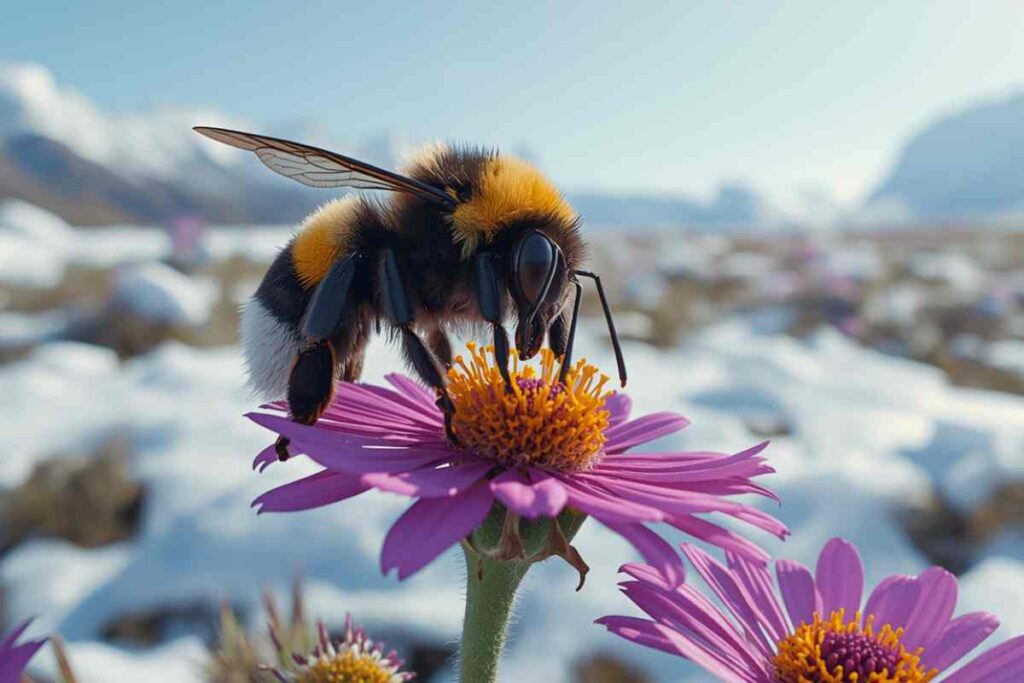

Yes, polar bees do exist, but not in the way many people imagine. You won’t find bees flying over sheets of ice at the exact North or South Pole. Instead, when people say polar bees, they are usually talking about a real Arctic insect known as the Arctic bumblebee.
The term polar bees is a common name, not a scientific one. These bees live in some of the coldest land regions on Earth and have evolved incredible ways to survive extreme conditions. In this guide, you’ll learn what polar bees really are, where they live, how they survive freezing temperatures, and why they matter far more than most people realize.
What Are Polar Bees?
Polar bees are cold-adapted bumblebees that live in the Arctic. The most well-known species is Bombus polaris, often called the Arctic bumblebee.
People call them polar bees because they live closer to the North Pole than almost any other bee species. They are not honeybees and do not produce honey for storage. Instead, they focus on survival and pollination during a very short summer window.
In simple terms, polar bees are tough, fuzzy bumblebees built to handle cold that would kill most insects.
Where Do Polar Bees Live?
Polar bees live in high Arctic regions, including northern Canada, parts of Greenland, and Arctic islands. These areas experience long, dark winters and extremely short summers.
They do not live at the actual North Pole, which is covered by moving sea ice and has no flowering plants. Bees need land and flowers to survive, so they stay on nearby tundra.
It’s also important to clear up a common misunderstanding. The Arctic and Antarctic are very different. The Arctic has land, plants, and insects. Antarctica does not support bees at all. Polar bees exist only in the Arctic, not the southern polar region.
Polar Bees vs Regular Bees (Key Differences)
Before listing differences, it helps to understand why comparison matters. Many people imagine polar bees behaving like garden bees, which is not accurate. Their entire biology is shaped by cold and time pressure.
| Feature | Polar Bees (Bombus polaris) | Common Bumblebees |
|---|---|---|
| Habitat | High Arctic tundra | Temperate regions |
| Body size | Larger, heavier | Smaller |
| Fur density | Extremely dense | Moderate |
| Flying temperature | Near freezing | Mild to warm |
| Active season | 4–8 weeks | Several months |
| Main challenge | Extreme cold | Predators, pesticides |
This difference explains why polar bees cannot survive outside cold regions and why regular bees cannot survive in the Arctic.
Physical Adaptations That Help Polar Bees Survive
Polar bees look different for a reason. Their bodies are designed to conserve heat and energy.
They have thick, long fur that works like insulation. This fur traps warm air close to their bodies and reduces heat loss in icy winds.
Their dark coloration helps absorb sunlight. Even weak Arctic sun can raise their body temperature slightly, which matters in near-freezing conditions.
Polar bees also have strong flight muscles and larger wings, allowing them to fly in dense cold air. However, they cannot store much energy. This means they must feed often and cannot survive long periods without flowers.
How Polar Bees Generate Body Heat
Polar bees are not warm-blooded, but they can actively produce heat when needed.
First, they disconnect their wings from their flight muscles.
Next, they rapidly contract those muscles without flying.
This movement creates heat, similar to how humans shiver.
Their flight muscles are powerful enough to raise body temperature to around 38°C (100°F), even when the air is close to freezing.
This heat allows short flights and feeding sessions. However, the warmth does not last forever. Once energy runs low, the bee must feed again or stop moving to avoid freezing.
Life Cycle of Polar Bees in Extreme Conditions
Life in the Arctic is fast and unforgiving. Polar bees have no time to waste.
Only fertilized queens survive the winter. They hibernate underground or in moss, protected from deadly temperatures.
When snow melts, the queen wakes up and immediately starts building a nest. She lays eggs, gathers food, and keeps them warm herself.
Workers develop quickly and take over foraging. If bad weather blocks flowers for even one week, the entire colony can fail. Timing is everything.
What Do Polar Bees Eat?
Polar bees feed on nectar and pollen from Arctic flowers. These plants bloom for only a few weeks each year.
Nectar quality matters because bees need high-energy sugar to produce heat. Weak nectar means less flying and less survival.
Food shortages are common due to sudden snow, wind, or cold rain. Because of this, polar bees and Arctic plants depend heavily on each other to survive.
Relationship Between Polar Bees and Arctic Plants
This relationship is a tight partnership. Many tundra plants rely almost entirely on polar bees for pollination.
Without bees, plants fail to produce seeds. Without plants, bees starve.
If polar bees disappear, the Arctic landscape would slowly lose flowering plants. That would affect birds, mammals, and the entire food chain.
Natural Threats in the Arctic
Even in remote regions, polar bees face serious threats.
Some parasitic bees invade their nests and take over their workers. Predators such as birds and spiders also pose risks.
Weather instability is another danger. Sudden storms, frost, or heavy winds can stop foraging and cause starvation within days.
Climate Change and Its Impact on Polar Bees
Climate change is one of the biggest threats to polar bees.
Warmer temperatures can cause timing mismatches. Flowers may bloom before bees wake up, leaving no food when it’s needed most.
Southern bee species are also moving north, bringing new diseases and competition. Polar bees are specialists in cold. As cold disappears, so does their advantage.
Why Polar Bees Matter to the Planet
Polar bees help maintain ecosystem stability in fragile Arctic environments.
They support plant diversity, which supports animals, soil health, and carbon balance. Losing them would trigger a chain reaction that affects far more than insects.
Even though they live far from cities, their role connects to global biodiversity and climate systems.
Are Polar Bees Endangered?
Polar bees are not officially extinct, but they are vulnerable.
Scientists are still learning how many exist and how fast populations are changing. Research is ongoing, especially in monitoring climate effects and habitat shifts.
The biggest challenge is lack of long-term data, not lack of concern.
How Humans Can Help Protect Polar Bees
Protection starts with supporting climate research and Arctic conservation programs.
Awareness also matters. When people understand how fragile Arctic ecosystems are, it becomes easier to protect them.
Reducing global warming helps not only polar bees but every species that depends on stable climates.
Common Myths About Polar Bees
“They live at the North Pole.”
They live near it, not on the ice-covered pole itself.
“They like cold weather.”
They tolerate cold because they must, not because they enjoy it.
“They are aggressive.”
Polar bees are generally calm and focused on survival, not attacking humans.
FAQs
Do polar bees make honey?
No, polar bees do not make honey. They collect nectar only for immediate energy to survive the cold Arctic environment.
Can polar bees survive outside the Arctic?
Usually not. Warmer climates disrupt their life cycle, making it hard for them to survive or reproduce successfully.
How long do polar bees live?
Workers live for only a few weeks during the short Arctic summer. Queens can live over a year, surviving through hibernation in winter.
Are polar bees important pollinators?
Yes, polar bees are crucial for Arctic plant survival. They help flowers produce seeds, supporting the entire tundra ecosystem.
Can climate change wipe them out?
If Arctic temperatures keep rising, their habitat may shrink or disappear. This could threaten their survival and the plants they pollinate.
Conclusion: Small Bees, Big Role in the Arctic
Polar bees may be small, but their role is enormous. They keep Arctic ecosystems alive, support fragile plants, and show how life adapts against impossible odds.
Understanding polar bees helps us understand the Arctic itself. Protecting them means protecting a delicate world that affects us all, even from thousands of miles away.